April 17, 2026
Skills I Didn't Expect to Matter
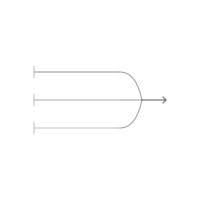
A year ago, if you’d asked me what skills matter for building data platforms, I’d have said: SQL, infrastructure-as-code, distributed systems, domain knowledge. Those still matter. But the skills that separate good days from frustrating ones are things I never would have put on that list.
Parallelization thinking
Not the distributed-systems kind. The project-management kind.
Sequential (old way):
  [scaffold model] --> [draft SME questions] --> [research vendor format] --> ...
  Total: 3 hours

Parallelized (new way):
  [scaffold model]—————————>|
  [draft SME questions]————>|--> integrate
  [research vendor format]——>|
  Total: ~1 hour
When you can spin up an AI agent for one task while you’re drafting questions for a domain expert while another agent researches vendor data formats — the skill is seeing that these can happen simultaneously. I’ve started approaching my work more like a producer than a programmer. What can run concurrently? What’s on the critical path?
The people who get the most out of AI tools aren’t necessarily the best coders. They’re the ones who can decompose work into independent streams.
Knowing when to delegate vs. do
Should I write this myself, or describe what I want and let the AI write it? The answer isn’t always “delegate.” Sometimes writing the code is how I figure out what I actually want. Sometimes explaining a tricky edge case in English takes longer than just handling it in Python.
The skill is recognizing which mode you’re in: exploring (do it yourself, think through it) vs. executing (describe it, delegate it, move on). Years of muscle memory say “open the editor, start typing.” Interrupting that to ask “should I be typing or directing?” takes deliberate practice.
Taste as a technical skill
When the AI generates code faster than you can read it, the scarce resource becomes judgment. Does this approach make sense? Will this schema hold up when the data changes?
In life sciences data work this matters especially. A pipeline might be technically correct but scientifically nonsensical. A schema might be clean but impossible to use for the analysis it was meant to support. The AI doesn’t know these things. You do — or you know who to ask.
The meta-skill
I keep a loose list of moments where I think “that took way longer than it should have” or “that went surprisingly well.” The patterns in those moments are where the real lessons are. Not in anyone’s best practices guide — in your own friction log.